 Viktar Patotski ·
· AI
· 7 min read
Viktar Patotski ·
· AI
· 7 min read
Spring AI vs LangChain4j: Which Java AI Framework to Pick in 2026
You run a Java product and want to add an AI feature. There are two real framework choices. Here is the honest comparison across providers, RAG, tools, Spring fit, and the one thing that decides it for most teams.
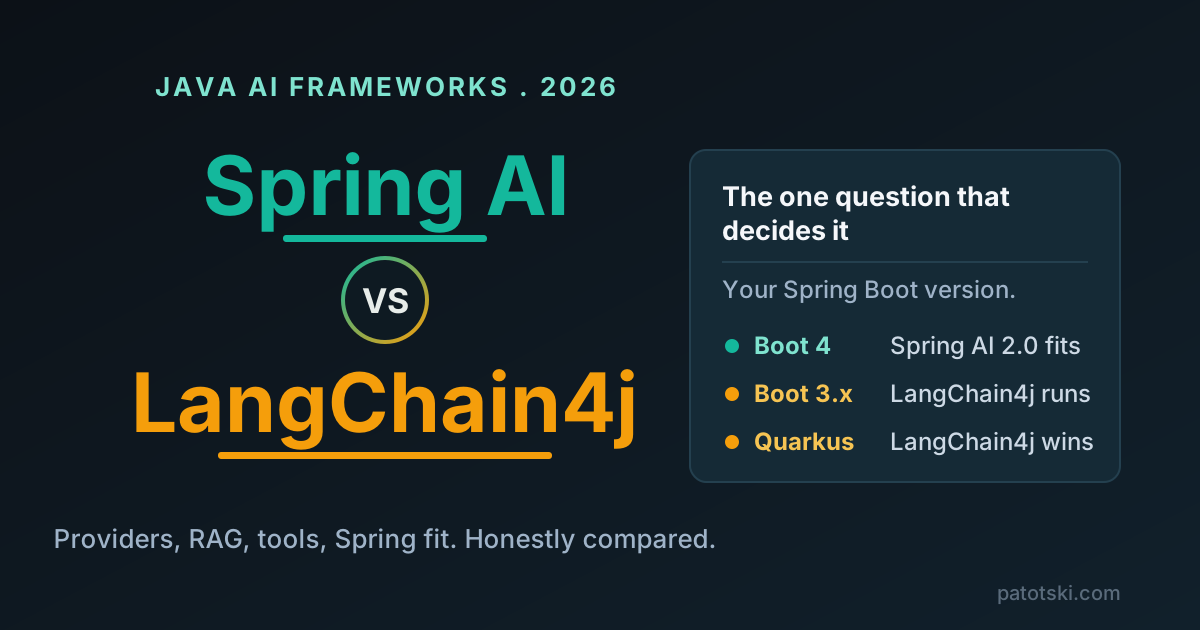
You already run a Java product. Now the roadmap has an AI feature on it, a support assistant, a document search, a “summarize this” button, and you do not want to stand up a Python service and a second deployment pipeline just to call a model. Good news: you do not have to. Two mature Java frameworks cover this, and for most teams the choice comes down to one question you can answer in a minute.
This is the honest comparison: Spring AI and LangChain4j, as of July 2026. Both move fast, so every version and claim here is dated, and you should re-check the two things that matter to you before you commit.
The 30-second verdict
| If you are… | Pick |
|---|---|
| Already on Spring Boot 4 / Framework 7 | Spring AI 2.0 |
| On Spring Boot 3.x and want AI now | Spring AI 1.1.x (maintained) or LangChain4j |
| On Quarkus, Micronaut, or any non-Spring stack | LangChain4j (Spring AI needs Spring) |
| Wanting the widest provider and vector-store menu | LangChain4j |
| Wanting the deepest Spring-native DI and observability | Spring AI |
If you take nothing else: your Spring Boot version decides more than any feature checkbox. More on that below.
The two contenders
Spring AI is the Spring team’s own project (maintained under the official
spring-projects organization, backed by Broadcom). It treats an AI model like
any other Spring resource: a starter, some properties, a ChatClient bean you
inject. If your mental model is “how Spring does datasources”, Spring AI is that,
for models. It reached 1.0 GA in May 2025 and 2.0 GA in June 2026.
LangChain4j is a community-driven, independent project (not affiliated with the Python LangChain company). It is broader and more model-first than Spring-first, with heavy contribution from the Red Hat and Quarkus side. It hit 1.0 GA in May 2025 and ships roughly monthly; the latest is 1.17.2 (July 2026). Its core is stable at 1.x, though a few integration modules and its agent module are still marked experimental.
The battle cards
The one that decides it: Spring Boot version
This is the single biggest gate in 2026. Spring AI 2.0 requires Spring Boot 4.0 or 4.1, Spring Framework 7, and Jackson 3. If your app is still on Spring Boot 3.x, you cannot adopt Spring AI 2.0 without a framework upgrade first. The Spring team maintains the 1.1.x line (currently 1.1.8) for Boot 3.x, so you are not stranded, but you are on the older stream.
LangChain4j sidesteps this entirely: it ships both a Boot 3.5+ starter and a separate Boot 4 starter, so it runs on either generation. During the Boot 3 to 4 transition window, that portability is a real advantage.
Verdict: on Boot 4 already, Spring AI 2.0 is a clean fit. Stuck on Boot 3.x and not upgrading soon, LangChain4j avoids the tie to your framework version.
Model providers
Both cover the providers that matter: OpenAI, Anthropic, Azure OpenAI, Amazon Bedrock, Google (Gemini / Vertex), Ollama for local models, Mistral. Spring AI 2.0 deliberately trimmed its core to about eight first-party providers and pushed the rest to vendor-maintained modules. LangChain4j advertises 20 or more providers and reaches further into niche and local options.
Verdict: tie for the mainstream. LangChain4j if you need something off the beaten path.
RAG and vector stores
Retrieval (RAG, retrieval-augmented generation, where you search your own documents and feed the results into the prompt) is where most vertical-SaaS AI features actually live. Both support the vector databases you would reach for: pgvector, Redis, Qdrant, Pinecone, Milvus, Chroma, and more. Spring AI wires retrieval through an “advisor” you attach to the chat client, which is opinionated and quick to stand up. LangChain4j exposes the pipeline as separate pieces (splitter, embedding store, retriever, ingestor), which is more granular and generally considered the more mature RAG toolkit.
Verdict: LangChain4j for control and depth, Spring AI for getting a standard RAG flow running fast.
Tools and function calling
Both let you expose a Java method to the model with a @Tool annotation and keep
it type-safe from the method signature. Spring AI 2.0 turned its tool loop into a
composable advisor and added progressive tool disclosure for when you have
hundreds of tools. LangChain4j has a mature annotation model with automatic
execution through its AI Services, plus tools imported over MCP (Model Context
Protocol, the emerging standard for connecting models to external tools).
Verdict: both solid and type-safe. Spring AI’s is the newer, more orchestration-oriented design.
Structured output
Getting typed Java objects back instead of a wall of text. Spring AI maps
responses to your classes with ChatClient.entity(YourType.class) and, in 2.0,
can use a provider’s native structured-output mode with self-correcting
validation. LangChain4j returns typed objects directly from AI Service methods
and uses JSON mode on models that support it.
Verdict: tie. Both do this well.
Streaming and observability
Both stream tokens. Spring AI is natively reactive (it returns a Project Reactor
Flux), which fits WebFlux cleanly; LangChain4j uses a callback stream and offers
a Reactor module as an opt-in dependency. On observability, both now expose
Micrometer metrics with the standard gen_ai.client.token.usage counter and
OpenTelemetry conventions, so you can see token spend and latency. Spring AI’s is
native and broader (it also instruments vector stores and images) and, notably,
does not log prompt or completion content by default, which is the right security
default.
Verdict: Spring AI leads if you are already reactive and want built-in metrics with no extra modules.
Spring fit
Spring AI is a native Spring project, so it always leads Spring Boot version
support and feels like the rest of your app. LangChain4j has a genuinely capable
Spring Boot starter (its @AiService annotation wires an AI-backed service like
any @Service), but its first-class home is Quarkus, where Red Hat maintains a
dedicated integration.
Verdict: Spring AI if Spring is your world. LangChain4j on Quarkus, and on any other non-Spring stack (Micronaut, Helidon, plain Java), since Spring AI needs Spring.
The scoreboard
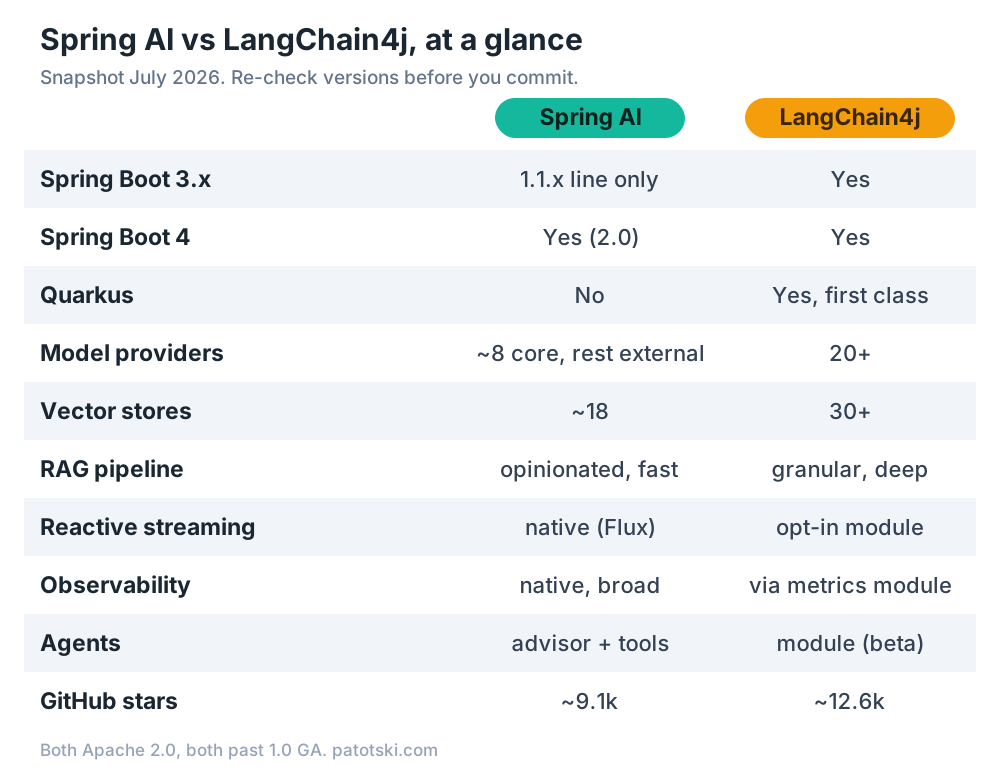
| Dimension | Spring AI | LangChain4j |
|---|---|---|
| Latest version (Jul 2026) | 2.0.0 (Boot 4) / 1.1.8 (Boot 3) | 1.17.2 |
| Governance | Spring team (Broadcom) | Community / Red Hat lean |
| Spring Boot 3.x | 1.1.x line only | Yes |
| Spring Boot 4 | Yes (2.0) | Yes |
| Quarkus | No | Yes (first class) |
| Providers | ~8 core, rest external | 20+ |
| Vector stores | ~18 | 30+ |
| RAG maturity | opinionated, fast | granular, deep |
| Native reactive streaming | Yes | Opt-in module |
| Built-in observability | Native, broad | Via metrics module |
| Agents | advisor + tools | dedicated module (experimental) |
| License | Apache 2.0 | Apache 2.0 |
| GitHub stars | ~9.1k | ~12.6k |
Pick by scenario
- Spring Boot 4 shop, standard AI feature. Spring AI 2.0. It is the native fit, the DI and observability come for free, and you are on the current stream.
- Spring Boot 3.x, not upgrading this quarter. LangChain4j, or Spring AI 1.1.x if you want to stay in the Spring family and accept the older line.
- Quarkus, Micronaut, or any non-Spring stack. LangChain4j, no contest. Spring AI is Spring-coupled, so it is not really in the running off Spring.
- Heavy, custom RAG over your domain data. LangChain4j for the finer-grained pipeline, unless you value speed-to-first-version over control.
- You just want a support assistant live next sprint on a Spring app. Spring
AI. Starter, properties,
ChatClient, done.
The honest verdict
There is no wrong choice here; both are Apache-2.0, both are past 1.0, both cover the real work. The decision is mostly about where you already stand, not about a feature you are missing. Spring AI is the safe, native pick if you live in Spring and can be on Boot 4. LangChain4j is the more portable, provider-rich pick, and the only real option off Spring (Quarkus, Micronaut, plain Java) or if you are pinned to Boot 3.x for a while.
One caution that applies to both: this space changes monthly. Pin your framework and model versions, put the token-usage metrics in from day one, and keep the provider abstraction clean so you can switch models when pricing or quality shifts. That last point matters more than the framework you pick.
Snapshot: July 2026. Spring AI 2.0.0 / 1.1.8, LangChain4j 1.17.2. Re-check current versions before you commit.
Adding AI to a product you already run is an architecture decision before it is a model decision. If you want a second pair of hands on the build-or-buy call, the cost model, or the integration, that is what I do under AI Enablement. Related on this site: what an LLM feature really costs and why model access is now a supply-chain risk.