 Viktar Patotski ·
· Security
· 10 min read
Viktar Patotski ·
· Security
· 10 min read
SOC 2 for SaaS Startups: What It Actually Costs in 2026
Audit fees, compliance platforms, pentests, and the engineering time nobody budgets. A realistic first-year SOC 2 number for a single-product SaaS team under 50 people, with sources.
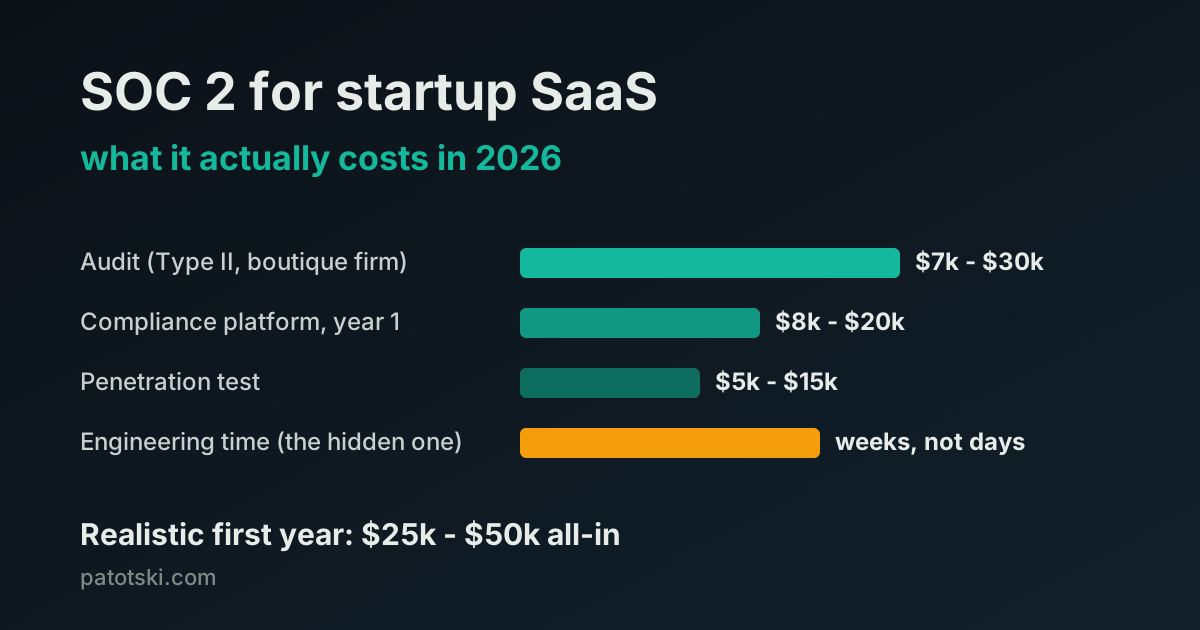
TL;DR: A small SaaS company gets through SOC 2 Type II for $25k-$50k all-in in year one: $7k-$30k for the audit itself, $8k-$20k for a compliance platform (list is $14k-$15k at the smallest tier and nobody should pay list), $5k-$15k for a penetration test if your auditor wants one, and several weeks of engineering time that never shows up in any vendor’s pricing page. The cheap path exists, and so do three traps that quietly double the bill: renewal pricing, scope creep, and starting Type II before your controls have actually run for a while.
SOC 2 cost at a glance
For a single-product SaaS company under 50 people. Every number is sourced in the sections below.
| Question | Short answer |
|---|---|
| First-year cash budget, all-in | $25k-$50k (lean path ~$23k, comfortable path ~$67k) |
| Audit fee alone | $7k-$30k |
| Compliance platform (Vanta, Drata, others) | $8k-$20k per year negotiated; list is $14k-$15k at the smallest tier |
| Penetration test | $5k-$15k, if your auditor wants one |
| Engineering time | 2-6 weeks of one senior engineer over a quarter (5-15 engineers) |
| Year two | $15k-$30k: renewals, platform, pentest |
| Time to a Type I report from a standing start | 3-4 months |
| Time to a Type II report | 8-12 months |
Why you’re suddenly Googling this
Nobody wakes up wanting SOC 2 (System and Organization Controls 2, an audit report that attests your security controls actually work). What happens instead: your biggest deal of the quarter stalls because the buyer’s procurement team sent a security questionnaire, and question three is “please attach your SOC 2 report.”
That’s the moment. SOC 2 is a sales unlock dressed up as a security project. Enterprise and mid-market buyers use it as a filter, and for a vertical SaaS selling into legal, healthcare-adjacent, insurance, or construction firms with corporate IT departments, the filter is getting more common every year. If your deals are all SMB self-serve, you can wait. The day a $50k+ contract asks for the report, the math changes fast: one closed deal pays for the whole thing.
I work in GovTech and healthcare, where compliance is a daily constraint rather than a one-time project, and the pattern I keep seeing founders hit is the same: the vendor pricing pages quote one number, and the real first-year spend is roughly double it. This post is the budget I wish someone had handed me: every line item, real ranges, and the three places the money leaks.
SOC 2 type 1 vs type 2 in one paragraph
A Type I (type 1) report says your controls were designed correctly on one specific day. A Type II (type 2) report says they actually operated over an observation window, usually 3 to 12 months. Buyers know the difference: Type I is a learner’s permit, Type II is the license. Some procurement teams accept a Type I plus a commitment to Type II; many now skip straight to asking for Type II. The practical play for most startups: get Type I fast to unblock the stalled deal, start the Type II observation window the same week.
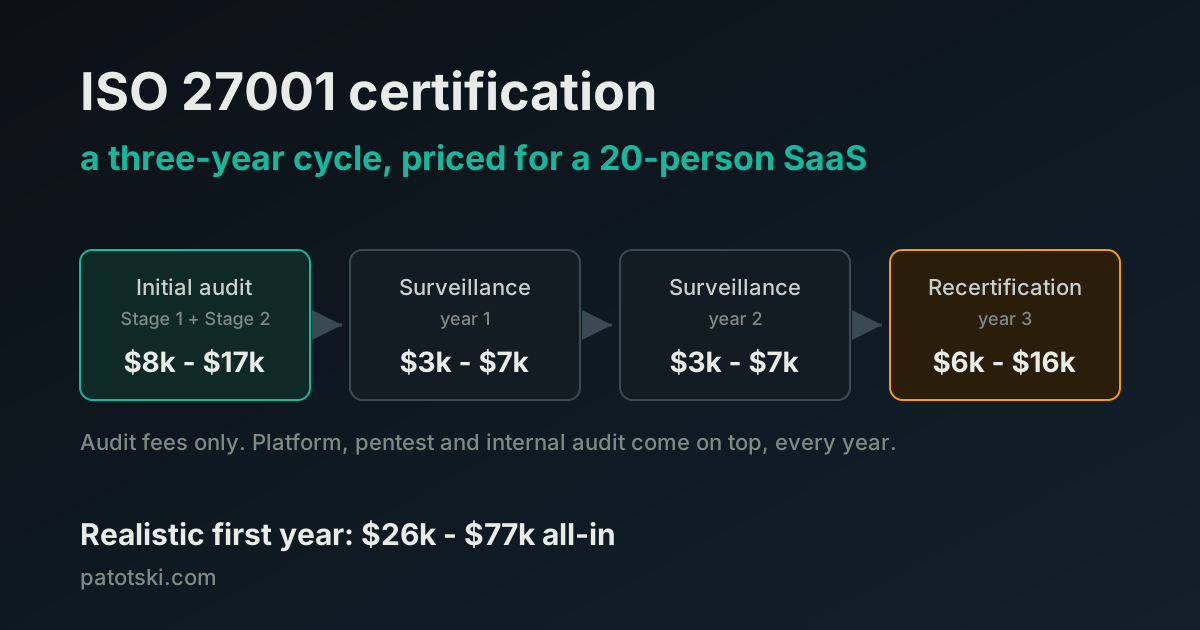
One terminology note that saves you a procurement argument: there is no “SOC 2 certification,” strictly speaking. SOC 2 is an attestation: a CPA firm’s opinion in a report, not a certificate from a standards body. Everyone, including the people budgeting for it, still says certification, and the cost is the same whatever you call it. If your buyer is in Europe and asks for an actual certificate, that is ISO 27001, a different program with its own audit math: ISO 27001 certification for SaaS, steps and cost.
The line items
1. The audit itself: $7k-$30k for most startups
A licensed CPA firm has to issue the report. Pricing depends on three things: firm tier, how many Trust Services Criteria you include beyond Security (Availability, Confidentiality, Processing Integrity, Privacy), and how messy your environment is. Across the whole market the tracked Type II spread runs $15.5k to $200k (one dataset of 172 CPA firms), and a single-product startup on a Security-only scope sits in the bottom third of that.
- Big 4 firms: out of a startup’s budget, and overkill. Their name on the report impresses nobody who matters at your stage.
- Boutique and specialist CPA firms: tracked pricing across the firms startups actually use puts a standard Type II at $12k-$30k (Johanson, Prescient, Thoropass all land in that band), with Type I running $5k-$20k. Workstreet, Vanta’s biggest audit-prep partner, quotes $12k-$20k for a small-company Type II.
- Fixed-fee and platform-partnered auditors: if you run a compliance platform (next section), its partner firms audit against evidence the platform already collected. Type I runs $5k-$7.5k with advertised floors at $2.5k for a security-only scope, and fixed-fee shops publish Type II at $7k-$10k. Below roughly $5k, ask what auditor hours you are actually buying; one security firm calls $3k-$5k audits a red flag.
Scope discipline is the biggest cost lever here. Security-only is the right scope for a first report. Every extra criterion adds auditor hours; one auditor’s published rate card: $20k for Security alone vs $26k with Availability and Confidentiality added. Add criteria later, when a specific buyer demands them.
2. The compliance platform: $8k-$20k per year, negotiated
Vanta, Drata, Secureframe, and a dozen smaller competitors. They connect to your AWS account, your identity provider, your MDM, and your HR tool, then continuously collect the evidence the auditor needs. You can do SOC 2 without one, on spreadsheets and screenshots. For a team with no dedicated compliance person, the platform pays for itself in saved engineering hours alone.
None of the vendors publish prices on their own sites. The only vendor-published numbers anywhere are their AWS Marketplace listings: Vanta Essentials at $14,000/yr for 1-20 employees and Drata Foundation at $15,000/yr for 1-50 people. Treat those as list price, and treat list price as the opening offer.
Transaction data says nobody pays list. Vendr’s tracked purchases put Vanta at a $20,000 median across 373 tracked purchases with observed lows at $7,500, and Drata’s median near $24,600; sub-50-person companies buying a single framework mostly land at $12k-$20k. Startup partner discounts of 25% (YC, AWS Activate, Ramp) are routine, and negotiated small-tier deals go lower still, into the $5k-$9k range. Budget $8k-$12k for the smallest tier if you negotiate, $15k-$20k if you take list or add a second framework.
The trap nobody mentions on the sales call is the renewal. Buyers report renewal quotes jumping 40-100% when headcount crosses a tier or a framework gets added (one reported Drata deal went $7.5k in year one to $15k at renewal); others report flat renewals for years. The defense is the same either way: negotiate a multi-year rate cap before you sign, while you still have leverage.
3. The penetration test: $5k-$15k
Not strictly required by SOC 2. The Trust Services Criteria only ask for ongoing evaluations “including penetration testing” (criterion CC4.1), so it is expected evidence rather than a hard mandate, but most auditors want to see one and most buyers’ questionnaires ask for it anyway, so budget it. Engagements run $5k-$15k depending on scope. For a single web app with an API, the low end of that range from a credible boutique firm is enough. You’ll repeat it annually, and for a Type II the test has to fall inside your observation window to count as evidence.
4. The readiness gap: $0-$25k
A readiness assessment (also sold as a gap assessment) is a paid dry run: someone walks your environment, finds the gaps, and gives you the fix list before the real audit. Standalone, it runs $5k-$25k. With a compliance platform you mostly don’t need it; the platform’s gap dashboard is the readiness assessment. Skip this line unless your environment is unusual (on-prem components, exotic stack, prior audit failures).
5. Engineering time: the line item that isn’t on any invoice
This is the one that blows up timelines. The platform tells you what’s missing; someone still has to do it. On a typical startup gap list:
- Enforce SSO and MFA everywhere, including that one legacy admin panel
- Turn on and actually review access logs
- Offboarding that revokes access the same day, provably
- Vendor inventory and risk review
- Incident response plan, tested once, with evidence
- Background checks and security training with completion records
- Branch protection, code review rules, separated deploy permissions
For a 5-15 person engineering org with reasonable AWS hygiene, that’s two to six weeks of one senior engineer’s time spread over a quarter, plus a permanent few-hours-a-month tax to keep evidence flowing. If your infrastructure is one big shared AWS account with everyone on admin keys, multiply accordingly. The controls themselves are things you should mostly have anyway; SOC 2 just makes you prove them.
The realistic first-year budget: SOC 2 certification cost, all-in
| Line item | Lean path | Comfortable path |
|---|---|---|
| Audit (Type I + Type II, platform-partnered, security-only) | $10k | $25k |
| Compliance platform, year 1 | $8k | $18k |
| Penetration test | $5k | $12k |
| Readiness assessment | $0 | $12k |
| Cash total, year 1 | ~$23k | ~$67k |
Add the lines and most single-product startups land in the $25k-$50k band; the lean end is real if you keep scope tight and negotiate the platform. Year two is cheaper in cash ($15k-$30k: Type II renewals run 75-90% of the initial audit fee, plus platform renewal and pentest) but it never goes to zero. SOC 2 is a subscription, not a diploma.
And the timeline: the Type I audit itself takes 4-8 weeks once your platform dashboard is green, but from a standing start budget 3-4 months to the report (Vanta’s own onboarding plan is about 12 weeks, plus 4-6 weeks for the auditor to issue). Type II adds the observation window on top. The AICPA sets no minimum window; 3 months is the market’s floor and 3-12 months the practical range, and a 3-month report tends to draw Type I-level follow-up questions from procurement. So the honest answer to “when will we have the Type II report” is eight to twelve months from a standing start.
The three traps that double the bill
Starting Type II too early. Your observation window starts when your controls are running, not when you sign the platform contract. Start the window with half your controls failing and the auditor documents exceptions, buyers read the exceptions, and you pay for a re-audit. Run the platform until the dashboard is green, hold it green for a few weeks, then start the clock.
Letting the platform pick the auditor without shopping. Partner auditors are convenient and often cheap, but “often” is doing work in that sentence. Get two or three quotes anyway; the spread between quotes for the same scope can be thousands of dollars.
Treating it as a paperwork project. The companies that suffer are the ones that bolt on controls as theater: a wiki page titled “Incident Response Plan” nobody has read, an access review that’s a quarterly rubber stamp. The audit cost is the same either way. The difference is whether you get an actual security upgrade for the money or just a PDF.
What I’d tell a founder budgeting this today
Take the lean path unless a specific buyer forces otherwise: compliance platform, security-only scope, platform-partnered auditor after comparing quotes, low-end pentest, no standalone readiness assessment. Budget $25k-$30k cash and a quarter of background engineering effort, and start the moment enterprise deals appear on the horizon. The report is table stakes in more and more verticals; the security work behind it is stuff you’d want before a breach anyway, and it’s a lot cheaper to build on a calendar you chose than during a procurement deadline you didn’t.
Sources
- Platform transaction data: Vendr on Vanta (373 tracked purchases) and Vendr on Drata
- Vendor list prices: Vanta Essentials on AWS Marketplace, Drata Foundation on AWS Marketplace
- Audit firm pricing: soc2auditors.org startup auditor directory and audit cost data, Workstreet, Sprinto, Cavanex, RedSec Labs on cheap-audit red flags
- Pentest and gap assessment ranges: Drata’s SOC 2 cost guide
- Pentest as expected evidence (criterion CC4.1): AICPA Trust Services Criteria
- Timelines: Vanta’s audit timeline, Cherry Bekaert on the observation window
- Renewal reports: buyer thread, r/cybersecurity
Staring down a security questionnaire right now? I help SaaS teams get the technical controls in place without derailing the roadmap: Security & Compliance consulting, or book a free 30-minute call and bring the questionnaire.