
ElastiCache Valkey Pricing: 20% Below Redis, 33% on Serverless
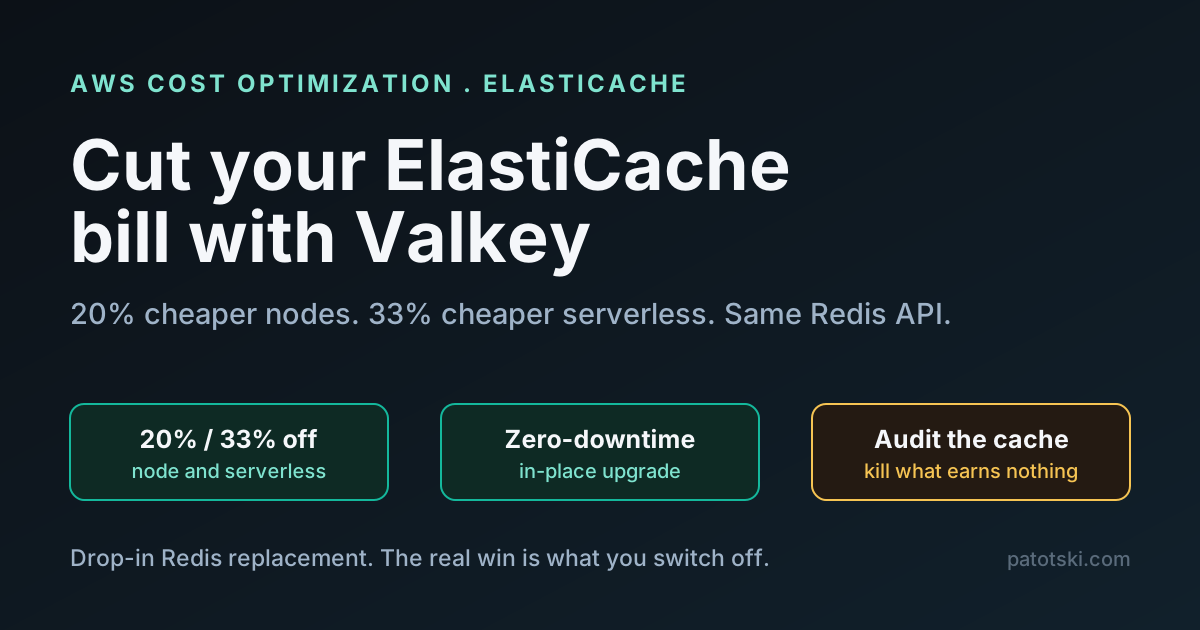
ElastiCache for Valkey is 20% cheaper than Redis on nodes and 33% on serverless, and the only engine eligible for a Database Savings Plan. Wire-compatible, in-place upgrade.
ElastiCache for Valkey is 20% cheaper than Redis on nodes and 33% on serverless, and the only engine eligible for a Database Savings Plan. Wire-compatible, in-place upgrade.

Karpenter can take 20 to 40 percent off your EKS compute bill, more with Spot, without refactoring a line of app code. Why it beats Cluster Autoscaler, the audit sequence to roll it out safely, and the gotchas that quietly cost people money.

Most AWS bills carry 20 to 40 percent waste, and cutting it does not take a FinOps team. This is the whole method in four steps: see where the money goes, kill the waste, pay less for what remains, and keep the bill down for good. Each step links to its own deep dive.

Your AWS bill is not a mystery, you just have not grouped it right. Cost Explorer is free and shows you where every dollar goes in about fifteen minutes. Here is the exact drill-down, which cost view to trust, and the one free alarm to set before you close the tab.

Graviton instances cost up to 20% less than the x86 equivalent for the same work. On managed services it is a setting you flip. On your own compute it is a real migration with real gotchas. Here is which workloads move for free, which take effort, and which cannot move at all.

Aurora can be cheaper than RDS or twice the price, and the deciding line item is the one nobody watches: I/O. Here is how the bill is built, when I/O-Optimized and Serverless v2 actually save money, and the traps that turn a managed database into your biggest surprise.